Image: Canva
Gestation Crates
The use of gestation crates has already been completely banned in countries such as Norway, Switzerland, the United Kingdom, and New Zealand, as well as in 11 US states: Arizona, California, Colorado, Florida, Maine, Massachusetts, Michigan, New Jersey, Ohio, Oregon, and Rhode Island. In Canada, their use is permitted only during the first 28 days after insemination, as is the case in the European Union. However, some EU Member States, including Sweden and Austria, have chosen to ban the practice entirely. In the Netherlands, crates are permitted only during the first four days after insemination. In new facilities in Denmark, gestation crates may be used for no more than three days, and this rule will apply to all production systems from 2035 onward. Germany has also voted to completely phase out the use of gestation crates by 2030.
In Brazil, Normative Instruction No. 113/2020, in force since 2021, established guidelines on good management practices and animal welfare on pig farms. These include limiting the use of gestation crates to a maximum of 35 days after breeding, with a 2045 deadline for farms to comply with the requirements.
Several Brazilian companies and cooperatives have made more ambitious commitments to eliminate gestation crates by 2031. This approach demonstrates leadership and reinforces the sector’s role in aligning itself with consumer expectations and global market requirements, establishing animal welfare as an integral part not only of the future, but also of the present of Brazilian pig farming.
Farrowing Crates
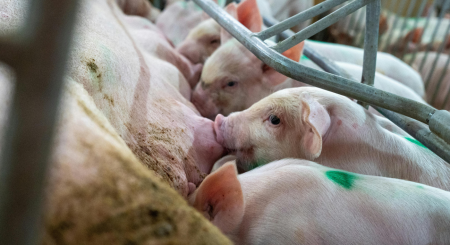
Like gestation crates, farrowing crates pose a serious animal welfare concern in pig farming. In addition to severely restricting sows’ movements, these systems fail to accommodate an essential behavior: the need to build a nest in a quiet, secluded area where they can give birth safely and comfortably. In practice, the conventional systems currently in use prevent sows from expressing this behavior.
Farrowing crates are completely banned in Sweden, Norway, and Switzerland. More recently, Germany voted to transition to a system in which sows may be confined in farrowing crates for no more than five days, while Austria allows their use for up to ten days after farrowing and has set 2033 as the deadline for a complete ban. In Finland, the construction of new facilities with farrowing crates has been prohibited since 2024. Denmark banned them in 2025, allowing farms a 15-year transition period to comply with the new requirements. Outside the European Union, New Zealand banned their use in 2020, setting a 2035 deadline for farms to transition, while the United Kingdom continues to discuss a potential ban.
In Brazil, Normative Instruction No. 113 does not provide for a ban on farrowing crates, stating only that they are “tolerated.” However, the regulation requires manipulable material to be provided before farrowing so that sows can express the important behavior of nest-building. Although corporate commitments do not yet include banning farrowing crates or reducing the length of time sows are confined in them, the sector must remain attentive to emerging trends. Animal welfare improvements tend to be implemented gradually. However, as progress is made on the most critical issues, it is essential for companies to incorporate new demands into their policies and practices, ensuring continuous progress in animal welfare.
Main guidelines of the normative text include:
- Restrictions on the use of gestation crates for up to 35 days starting in January 2045.
- Mandatory use of analgesia and anesthesia in all surgical castration procedures starting in January 2030.
- Restrictions on tail docking, which may be tolerated when only the final third of the tail is removed, and with procedures that minimize pain and health implications for the animals.
- Prohibition of ear notching starting in January 2030.
- Prohibition of teeth clipping, with grinding permitted only when necessary.
- Weaning of piglets at an average age of 24 days or older, starting in January 2045.
- Prohibition of electric prods and aggressive handling practices.
- Mandatory access to environmental enrichment.
- For breeding sows, the provision of suitable enrichment material before farrowing to support nest-building behavior.
Sources:
¹ Farm Animals Confinement Bans by State – RSPCA. Available at:
https://www.aspca.org/improving-laws-animals/public-policy/farm-animal-confinement-bans² IN 113/2020 – Ministério da Agricultura e Pecuária (MAPA)
³ Observatório Animal. Available at:
https://observatorioanimal.com.br/en/compromissos/galinhas-livres-de-gaiolas/⁴ Free Farrowing. Available at:
https://www.freefarrowing.org/know-the-rules/welfare-legislation/